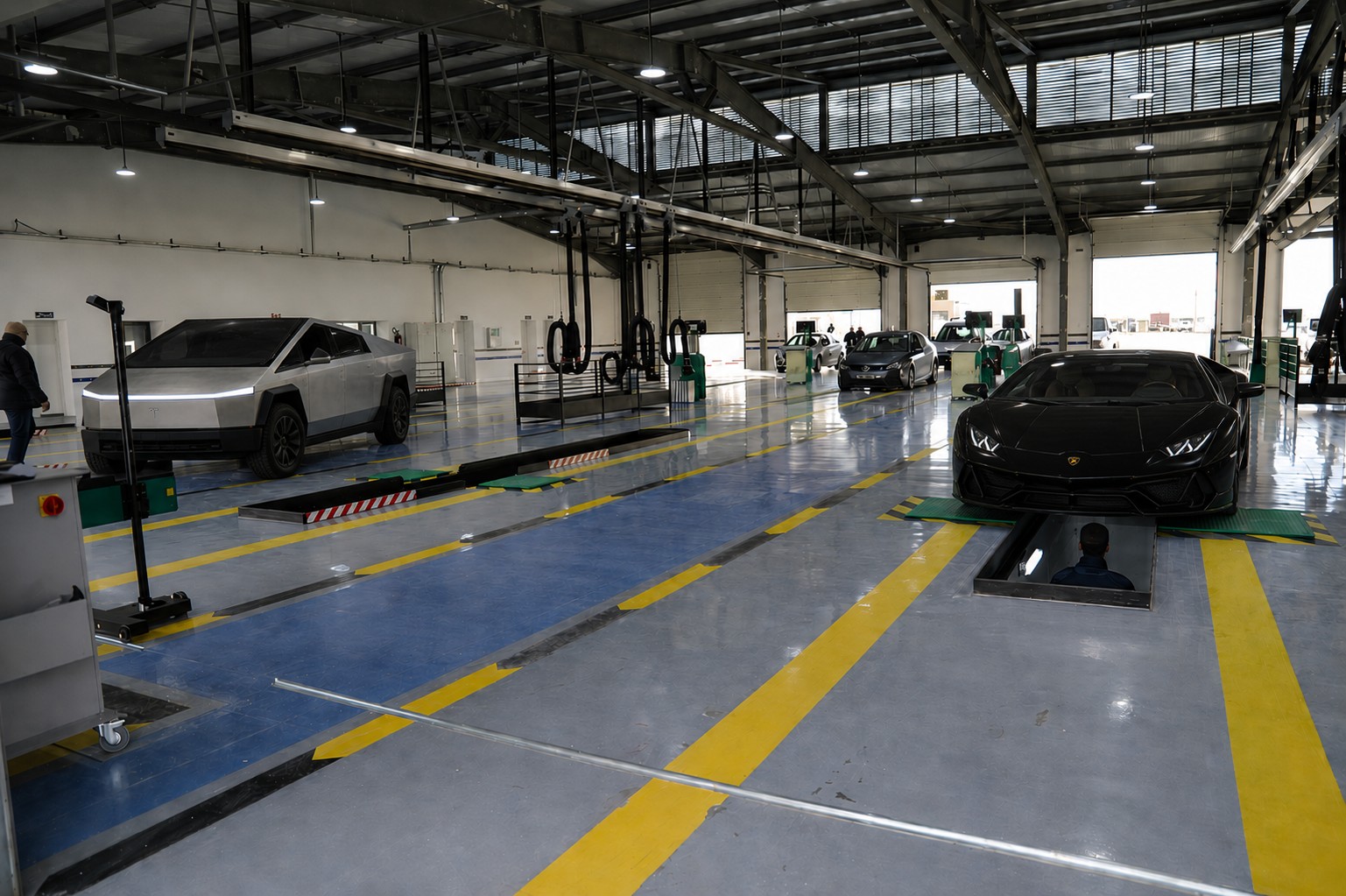
The technical inspection is one of the few administrative appointments that every vehicle owner in Tunisia ends up knowing by heart. It is managed by the Agence Technique des Transports Terrestres (ATTT), which operates around thirty centres spread across the whole country. Yet when it comes to the exact frequency, the real cost and what happens if the vehicle fails, many motorists rely on guesswork. Here are the rules as they apply today.
How often must the technical inspection be carried out?
The frequency is set by Decree no. 2000-148, which has been amended several times since. The rule affecting the greatest number of drivers changed in 2016: private cars, motorcycles, tricycles and motor quadricycles have their first inspection four years after they are first registered for road use, rather than three. After that, the inspection takes place every two years. And from the tenth year onwards, it becomes annual.
The other categories follow tighter schedules:
- Light commercial vehicles and road tractors: first inspection at 2 years, then every year. Beyond 10 years, every 6 months.
- Taxis, shared intercity taxis (louages) and rural public transport: first inspection at 1 year, then annually for the first few years before moving to every six months.
- Coaches, buses and tourist transport vehicles: first inspection at 1 year, annual until the third year, then every six months.
- Rental vehicles: first inspection at 1 year, then every 6 months.
- Agricultural tractors and their trailers: first inspection at 3 years, then every 2 years, and annually beyond 10 years.
Vehicles used for driving instruction are also subject to a stricter regime, moving to an inspection every six months after the first few years. A driving school therefore has a far denser inspection calendar than a private individual: a detail that weighs on its running costs.
How much does the technical inspection cost in 2026?
Since 1 January 2025, an additional duty of 5 dinars has been added to each technical inspection certificate, pursuant to article 15 of the 2025 finance act, for the benefit of the Social Protection Fund for Female Agricultural Workers. The applicable fees are therefore as follows:
|
| Private cars, motorcycles, tricycles and quadricycles | 36,5 DT |
| Light commercial vehicles (gross vehicle weight up to 3,5 tonnes) | 42 DT |
| Other vehicle categories | 43,5 DT |
If the vehicle fails, the chargeable re-inspection is still billed at the old rates: 21 dinars for a private vehicle, 26 dinars for a light commercial vehicle under 3,5 tonnes and 28 dinars above that.
💡Worth knowing: one free re-inspection is granted, once only, within 48 hours of the first registration of the file, not counting public holidays. If your car fails over something that can be fixed quickly, a bulb or a windscreen wiper for instance, it is often possible to return the next day without paying again.
How the inspection is carried out
The operation takes about thirty minutes and takes place at the centre of your choice. The ATTT has set up an online appointment booking system on its website, which lets you choose the centre, the date and the time, and pay for the booking in advance.
On arrival, you report to the registration desk with the original vehicle registration certificate and, for the vehicles concerned, the operating certificate. Once the documents have been checked and payment made, you are given a tracking sheet. You then join the queue for the inspection lanes, where an officer takes the wheel to put the vehicle through the test benches.
The inspection combines a visual examination with instrument-based measurements. It covers in particular the identification of the vehicle, the lights and emission levels, the chassis and suspension, the bodywork, the horn, the wheels and steering, the braking system, as well as measurements of suspension efficiency, service brake, handbrake and wheel side-slip.
If no defect is found, the technical inspection certificate is issued and the adhesive sticker is affixed inside the windscreen, on the right-hand side.
⚠️Important: no duplicate of this certificate can be issued. If it is lost, the entire process has to be repeated.
The three categories of defects
A failure does not have the same consequences depending on how serious the defect is. The regulations distinguish three categories.
A category 1 defect affects the very identity of the vehicle: identification numbers erased or altered, missing manufacturer's plate, falsified registration certificate or one that does not match the vehicle, significant unauthorised modifications. In this case, the registration certificate is withdrawn and forwarded to the Ministry of Transport's departments, and the report authorises use of the vehicle for fifteen days only.
A category 2 defect is a serious safety defect: inadequate braking, bald tyres, a fuel leak, a missing mirror or windscreen. The report authorises use of the vehicle for fifteen days, the time needed to carry out the repair.
A category 3 defect is a minor one: poor fastening, badly adjusted light, illegible plate. Here too, the report is valid for fifteen days, with no technical inspection certificate issued.
In all cases, if the report's validity period expires, or if more than one month has passed since the first registration, the entire inspection must be redone from the start.
What the technical inspection is not
Two confusions come up often. The first: when selling a vehicle, what is required for the transfer of ownership is not a technical inspection, but an identification certificate issued by a technical inspection centre and less than one month old. The two documents are different and do not replace each other.
The second: a valid certificate does not exempt you from anything. The text says so explicitly: the periodic technical inspection does not relieve the owner of the duty to keep the vehicle in good working order throughout the certificate's validity period. A successful inspection captures the state of the vehicle at a given moment; it does not guarantee it for two years.
Driving without a valid technical inspection
This is not a simple traffic fine. Article 85 of the Tunisian road rules classes as an offence the act of putting a vehicle on the road without submitting it to the technical inspection, or using an expired certificate. The penalty provided is a fine of 100 to 200 dinars, to which may be added, depending on the circumstances, the immobilisation of the vehicle.
Compared with the cost of an inspection at 36,5 TND, the choice is quickly made.
In summary
For a private car: first inspection at 4 years, then every 2 years, then every year from the tenth year onwards. Allow 36,5 dinars, around thirty minutes, and the original vehicle registration certificate in the glovebox. The rest — lights, tyres, wipers, fluid levels — can be checked the day before, and avoids most deferrals.
Driving well starts with learning well. Find your driving school anywhere in Tunisia with Drivago.
How often must the technical inspection be carried out in Tunisia?
For a private car, the first inspection takes place four years after the vehicle first entered service, then every two years. From the tenth year onwards, it becomes annual. Light commercial vehicles, taxis, rental vehicles and driving school vehicles follow more frequent schedules.
How much does the technical inspection cost?
36,500 dinars for a private car, 42 dinars for a light commercial vehicle up to 3,5 tonnes and 43,5 dinars for the other categories. These amounts include the 5 dinar duty introduced by the 2025 finance act. A chargeable re-inspection costs 21 dinars for a private vehicle.
What should I do if my vehicle is deferred?
You receive a technical inspection report valid for fifteen days, allowing you to drive and carry out the repairs. One free re-inspection is possible within the 48 hours following the first registration. Beyond the prescribed deadlines, the whole inspection must be taken again.