The manoeuvring test takes place in a dedicated off-road area, away from traffic. For category B, it is now the final stage of the practical test, with its own appointment after passing the on-road driving test.
How do you know you are ready?
Your driving instructor trains you directly at the centre where your test will take place. You are ready when you can perform the 4 manoeuvres one after another on that site without hesitation or excessive correction.
On the day of the test
Before you start
You report to the centre at the stated time and wait for your examiner. When they arrive, you hand over your file (given to you beforehand by your driving instructor) and your identity document.
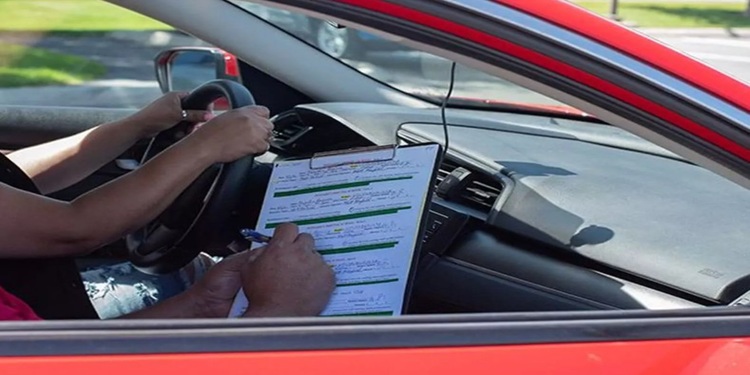
You get into the vehicle alone. Unlike the on-road driving test, the examiner does not sit with you in the car: they watch the whole test from a distance, from the manoeuvring area.
Getting started
Fasten your seat belt and wait for the signal before making any movement. Once you are given the go-ahead, start the engine and move to the starting point of the course.
⚠️Throughout the test, move the vehicle using the clutch only, always staying in first gear. Using the accelerator to move forward or to change gear is counted as a mistake.
The 4 manoeuvres, in order
The examiner does not announce each manoeuvre one by one. They give you a single starting signal, and you perform the 4 exercises in a row, in this order:
1. Driving forward through a narrow lane
- Line yourself up with the centre of the lane before moving forward.
- Move forward slowly, at a steady speed.
- Adjust the steering wheel with small corrections to stay centred.
- Use your mirrors to check both sides without stopping.
2. Parallel parking
- Line the vehicle up parallel to the designated space.
- Check that there is enough room to manoeuvre.
- Reverse slowly while turning the wheel to enter the space.
- Straighten the wheel during the manoeuvre to centre the vehicle.
- Adjust the final position: equal distance on each side, without going beyond the markings.
3. Turning round
- Stop, check your surroundings and signal your intention.
- Move forward with full lock in one direction.
- Just before reaching the limit, turn the wheel the other way and select reverse.
- Reverse with full lock in the other direction.
- Straighten up to set off in the opposite direction.
4. Reversing through a narrow lane
- Position the vehicle in line with the lane, ready to reverse.
- Turn round and use your mirrors to watch both sides.
- Reverse very slowly so that you have time to correct.
- Adjust the steering wheel with small inputs to stay centred until you come out of the lane.
Tolerated faults and eliminating faults
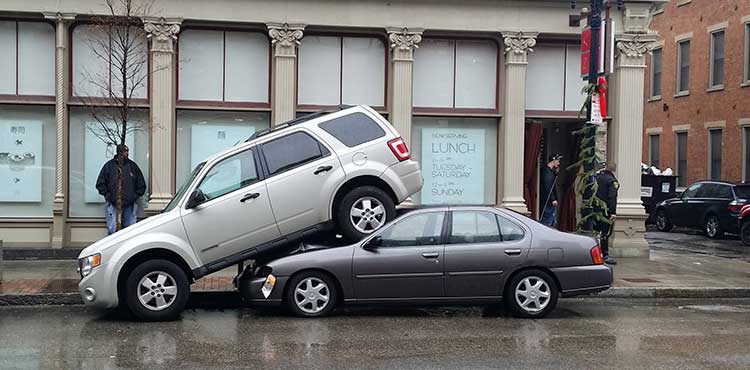
Small corrections or moments of hesitation are still tolerated as long as they do not put anything at risk. Hitting a cone, mounting the kerb or leaving the lane, on the other hand, are eliminating faults, which mean an immediate fail.
❌Hitting a cone, mounting the kerb or leaving the lane result in an immediate fail.
The result
If you pass, the examiner issues you a provisional driving licence while you wait for the original; this is the final stage of the test.
If you fail, you have a second attempt at the manoeuvres, usually scheduled shortly afterwards. If you fail both attempts, you will have to retake the on-road driving test before you can try the manoeuvres again.
Our tips
- Do not try to go fast: precision matters more than speed. Time is still monitored, though. The test usually lasts a maximum of 5 minutes, and candidates have been failed for going beyond that time.
- Always move the vehicle using the clutch, never the accelerator.
- Use your mirrors continuously, not just when you are reversing.
- If you feel you are drifting out of line, correct it straight away rather than waiting.
What are the 4 manoeuvres to perform, in order?
Driving forward through a narrow lane, parallel parking, turning round, then reversing through a narrow lane.
How long does the manoeuvring test last?
Usually a maximum of 5 minutes; going beyond that time can result in a fail.
What are the eliminating faults during the manoeuvres?
Hitting a cone, mounting the kerb or leaving the lane result in an immediate fail.
What happens if you fail the manoeuvres?
You have a second attempt, usually scheduled shortly afterwards. If you fail twice, you must retake the on-road driving test before you can try the manoeuvres again.