Every summer, thousands of Tunisians take to the road in Europe: holidays, family visits, studies, relocation. And the same question comes up: is my Tunisian licence enough? The short answer is yes, but only for a limited time. Beyond a certain threshold, it is no longer the licence that counts, but your place of residence.
A licence recognised under two international conventions
Tunisia is a party to the 1949 Geneva Convention on Road Traffic, which it joined as early as 1957, as well as to the 1968 Vienna Convention, ratified in January 2004. These two texts organise the mutual recognition of national driving licences between signatory countries.
A Tunisian driver on a tourist stay can therefore drive in France, Italy, Spain, Germany or Belgium without taking a local test. But this recognition applies only to people passing through: it lapses as soon as you establish your residence in the country.
The international driving permit: what it does, and what it does not do
Issued by the ATTT for around 30 dinars and valid for one year, the international driving permit is an official, standardised translation of your national licence. It never replaces it: both documents must be presented together. Nor does it grant any additional rights, and it is worthless in your own country of residence.
In Europe it is not systematically required, particularly in French-speaking countries. But it removes a great deal of ambiguity during a roadside check, and above all with vehicle rental companies, which very often require it in their terms and conditions.
💡The international driving permit must be applied for in Tunisia, before you leave. It cannot be obtained from Europe.
If you are travelling with your own car, by ferry to Marseille or Genoa, add the international insurance card, known as the "green card", and check the list of countries it covers.
"Normal residence": the rule that changes everything
This is the point many people discover too late. In most European countries, "normal residence" refers to the place where a person lives for at least 185 days per calendar year. As soon as it is established in Europe, your Tunisian licence is only recognised for a transitional period, generally six months to one year.
After that, there are two scenarios: either the country has concluded an exchange agreement with Tunisia and you obtain the local licence without a test, or there is no agreement and you have to retake the theory test and the practical driving test. One condition applies everywhere: the Tunisian licence must have been obtained before you settled in the country.
Country by country: the exchange conditions
- France: the licence is recognised for one year from the date you acquire normal residence. A reciprocity agreement allows an exchange without a test, to be applied for online on the ANTS within the year following the issue of your first residence permit. Students are an exception: their licence remains valid for the entire duration of their studies.
- Italy: an agreement signed on 16 January 2025 came into force on 20 July 2025 and runs until 2030. Conversion without a test, provided you are entered in the population register, have been resident in Italy for less than six years and did not obtain the licence after entering the country.
- Spain: Tunisia is on the list of countries under convention with the DGT. The licence is recognised for six months after obtaining legal residence. A medical and psychotechnical certificate is required, and the authenticity of the licence is verified with the Tunisian authorities, which lengthens the processing times.
- Germany: the most restrictive case: Tunisia does not appear in annex 11 of the German regulations. The licence is recognised for six months after residence is established, after which you must take the German theory and practical tests.
- Switzerland: exchange is compulsory within twelve months. Tunisia is exempt from the "control drive", but an additional theory test is still required.
- Belgium: use is possible for 185 days from registration with the municipality, then the licence must be exchanged with the municipal administration. As each licence is authenticated, the processing times can be long.
These rules change in line with bilateral agreements: always check with the administration of the country concerned or with the Tunisian consulate on site. Finally, note that professional categories, such as the heavy goods vehicle licence, often follow separate rules and may require an additional qualification in order to work.
In summary
For a trip, your Tunisian licence will take you anywhere in Europe, provided you add an international driving permit and valid insurance. For a relocation, everything is decided in the first few months. It is often administrative delay, rather than the absence of an agreement, that causes the loss of the right to drive.
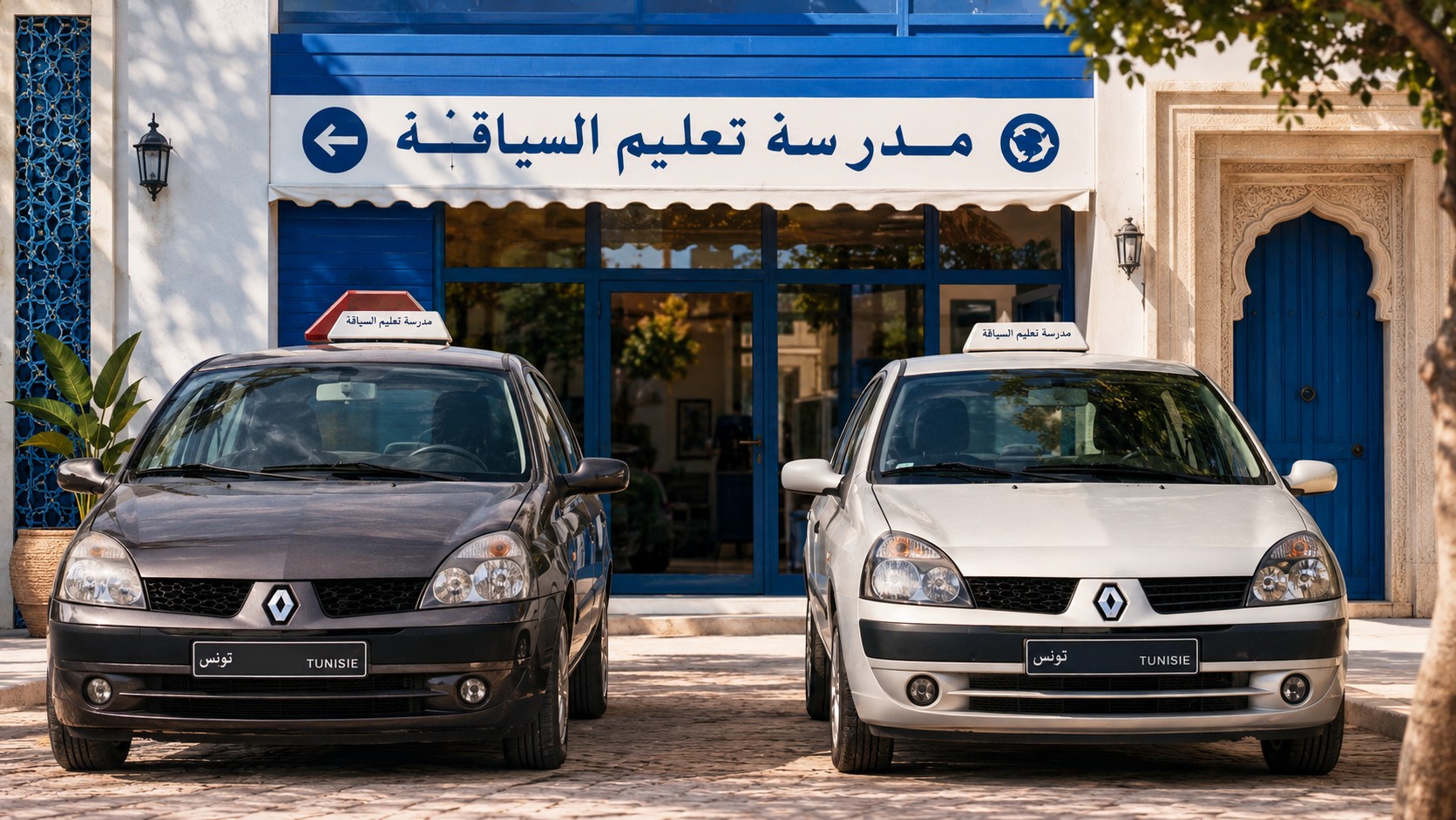
And it all starts with a licence obtained at a reputable driving school.
Find yours anywhere in Tunisia with Drivago.
Can you drive in France with a Tunisian licence?
Yes. For a tourist stay or during your studies, a valid Tunisian licence is enough. If you settle there long term, it remains recognised for one year from the date you acquire normal residence, and you must apply for the exchange within that period.
Is the international driving permit compulsory in Europe?
It is not required everywhere, but it is strongly recommended, particularly for renting a car. You apply for it from the ATTT before you leave, it costs around 30 dinars and remains valid for one year.
What happens if I miss the exchange deadline?
You lose the right to drive in the country concerned and must retake all or part of the local tests. Hence the importance of submitting your application during the first months of residence.